




When shopping for a new vehicle, most buyers focus on monthly payments, features, and capability. Those factors are important, but long-term maintenance costs deserve attention.
Fortunately, many of today’s Jeep® vehicles are designed with durability and everyday usability in mind. Choosing the right model can help keep routine maintenance predictable while still delivering the versatility and capability that attract buyers to the Jeep® brand in the first place.
Smaller Jeep® Models Often Bring Lower Ownership Costs
In general, compact SUVs tend to cost less to maintain than larger vehicles, and that trend carries into the Jeep® lineup.
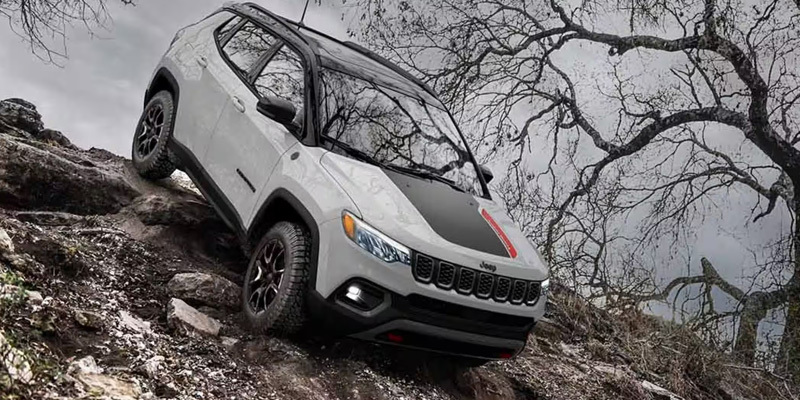
The Jeep® Compass is a good example. Powered by a Turbocharged 2.0L engine producing 200 hp and 221 lbs. ft. of torque, it delivers strong performance while keeping routine maintenance relatively straightforward. With seating for 5 and up to 59.8 cubic feet of cargo space, the Compass provides practical versatility without the complexity associated with larger SUVs.
The Jeep® Renegade is no longer available as a new model, making the Compass the entry point for many buyers seeking manageable ownership costs combined with genuine Jeep® capability.
The New Cherokee Finds the Middle Ground
The 2026 Jeep® Cherokee gives buyers another compelling option. Positioned between the Compass and Grand Cherokee, the Cherokee is designed for drivers who want additional passenger room and cargo flexibility without moving into a larger midsize SUV. It delivers the utility many families need while maintaining the maneuverability and everyday practicality that make smaller crossovers attractive.
For many buyers, the Cherokee represents a sweet spot within the lineup. It offers more space than the Compass while avoiding some of the size, weight, and ownership considerations associated with larger SUVs. That combination can make it one of the smartest long-term ownership choices in the Jeep® family.
Grand Cherokee Balances Capability and Long-Term Value
The Jeep® Grand Cherokee occupies a unique position in the lineup. It offers significantly more space than the Compass, including up to 70.8 cubic feet of cargo capacity, while maintaining a reputation as one of the brand’s most versatile SUVs. The standard 3.6L Pentastar® V6 produces 293 hp and 260 lbs. ft. of torque, providing strong everyday performance and towing capability. A newly available 2.0L Hurricane 4 Turbo engine puts out 324 hp and 332 lbs. ft. of torque for added power.
While maintenance costs are generally higher than those of a Compass, the Grand Cherokee often appeals to buyers looking for a balance of capability, comfort, and long-term durability. For many families, that combination justifies the additional ownership expense.
Wrangler Ownership Is Different by Design
The Jeep® Wrangler deserves its own category. Few vehicles can match its open-air driving experience and off-road capability, but buyers should understand that Wrangler ownership often looks different than ownership of a traditional crossover SUV.
The 2026 Jeep® Wrangler offers multiple powertrain options, solid axle construction, removable doors, and advanced four-wheel-drive systems. Those features are a major part of its appeal, but they also create maintenance considerations that differ from more road-focused models.
For buyers who genuinely plan to use a Wrangler’s capability, those tradeoffs are often well worth it.
Gladiator Offers Truck Utility with Jeep® Character
The 2026 Jeep® Gladiator combines Wrangler capability with pickup-truck versatility. Powered by the proven 3.6L Pentastar® V6, the Gladiator delivers up to 7,700 lbs. of towing capability and up to 1,725 lbs. of payload capacity when properly equipped. Buyers who need both cargo-bed functionality and genuine off-road performance often find it difficult to replace.
Like the Wrangler, maintenance costs depend heavily on usage. A Gladiator used primarily as a daily driver may have very different ownership costs than one that regularly sees trails, towing duties, or oversized tire upgrades.
Routine Maintenance Still Determines Long-Term Costs
No vehicle maintains itself. Regular oil changes, tire rotations, brake inspections, battery testing, and multi-point inspections remain the best way to control ownership costs regardless of which Jeep® you choose.
Following factory maintenance schedules helps identify wear items early and supports long-term reliability. It can also help preserve resale value, something many buyers overlook when calculating total ownership costs.
In many cases, consistent maintenance has a greater impact on long-term expenses than the specific model itself.
Explore the Jeep® Lineup Near La Porte, IN
The least expensive Jeep® vehicle to maintain depends largely on how you drive and what you expect from your SUV. For some buyers, the Compass delivers an ideal balance of affordability and practicality. Others may find the added space and capability of the Grand Cherokee better suits their needs. And for adventure-focused drivers, the Wrangler continues to stand in a class of its own. Visit La Porte CDJR today, your local Jeep® dealership, to compare the lineup in person, explore available features, schedule a test drive, and find the model that delivers the right combination of capability, comfort, and long-term value.
Connect with us


- June 2026
- May 2026
- February 2026
- December 2025
- October 2025
- August 2025
- July 2025
- June 2025
- May 2025
- April 2025
- March 2025
- December 2024
- October 2024
- September 2024
- August 2024
- July 2024
- May 2024
- March 2024
- January 2024
- August 2023
- March 2023
- November 2022
- September 2022
- January 2022
- November 2021
- October 2021
- September 2021
- August 2021
- July 2021
- February 2021
- December 2020
- September 2020
- April 2020
- February 2020
- January 2020
- December 2019
- November 2019
- October 2019
- September 2019
- August 2019
- July 2019
- June 2019
- May 2019
- March 2019
- February 2019
- January 2019
- December 2018
- November 2018
- September 2018
- August 2018
- July 2018